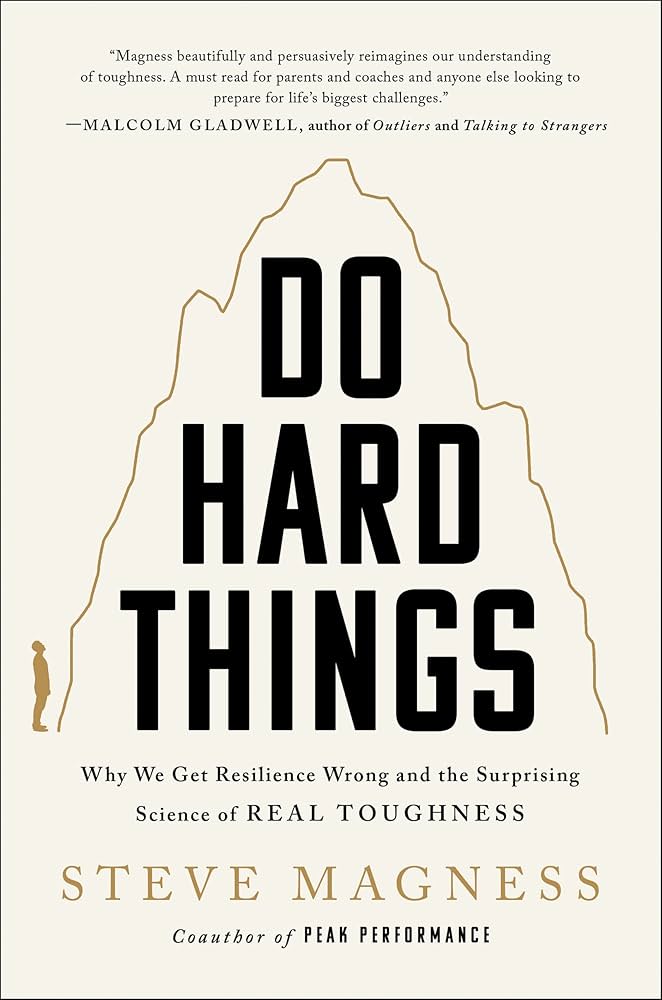
While not specifically focused on running, this book provides an excellent framework for facing the challenges of training head on. I love how the author provides research backed proof that we often get the underpinnings of toughness and grit wrong and how to best work to build up toughness to face challenges. The lessons learned in this book are easily applied to help you push through the hardest part of a workout or race.
The central theme of this book is the need to foster a skill set for toughness and be intentional in the process. Toughness is not simply pushing through blindly when things get hard, toughness is navigating discomfort and making the best decision. The author provides clear examples of how our culture has often gotten toughness wrong. Many times we’ve mistaken sorting (activities or challenges that simply weed out those who cannot handle the task) for training (actually providing a skill set and helping people grow) and mistakenly assumed challenges alone foster toughness. You need to form the skills for facing adversity first and then take on a challenge to help you test those skills.
The author spends the majority of the book overviewing the “pillars of toughness” including: ditch the facade embrace reality, listen to your body, respond instead of react, transcend discomfort.
Pillar 1: Ditch the facade embrace reality
This pillar focuses on the need to “align expected and actual demands through personal assessment of personal capabilities and demands”. When we are unable to handle a task we are put into a threat response which is not conducive for growth, so blindly trying to do something far out of our capabilities is not helpful. Instead we must seek goals that help us grow by pushing us in a way that feels attainable. The author overviews several strategies for achieving this including: set appropriate goals (just beyond your current limits) set authentic goals (meaningful to you not just others), define judgement and expectations (outcomes of goals and also process and effort needed to achieve those outcomes), course correct for stress (keep in mind fatigue and stress will cause you to overestimate effort needed), and prime your mind (stress shifts us to a negative mindset, when this happens try to search for opportunities not threats).
In this pillar the author also overviews building confidence. He points out, “true confidence has to be founded in reality, not elimination of doubt but allowing it to keep us in check”. The author overviews several ways to create inner confidence including: 1. Lower the bar, raise the floor (instead of defining yourself by your best, try to get better than your minimum expectation; work on improving your average and be consistent) 2. Shed perfection, embrace who you are (be realistic on what you are cable of and your weakness) 3. Trust your training, trust yourself (consistency in doing the work makes confidence founded in something concrete) 4. Develop a quiet ego (reasonable ego is effective in listening to others and self).
Pillar 2: listen to your body
This pillar focuses on how our bodies provide constant feedback to us on how our current environment is effecting us and listening to this feedback can help us better face challenges. Feelings and sensations indicate how taxing a task will be on our bodies. In order to use this feedback we must first notice it through noticing our feelings and sensations and then labeling them in a detailed way. Once we notices these we can use feelings and sensation for information or motivation or let them just pass by if they are not helpful.
Our feelings and sensations often impact our self-talk but we are able to take control of our thoughts to help us push through adversity. The author overviews several strategies for winning the inner debate when self talk becomes negative including: change your voice (let negative thoughts float by and verbalize positive thoughts), know what voice to listen to (positive self talk works when you have a degree of belief in what we’re saying is true), decrease the bond from me to she (self talk is more effective when using third person language as this distances us from the emotions of situation).
Pillar 3: Respond instead of react
This pillar focuses on being mindful in responding to pain or intense sensations/feelings instead of immediately reacting to it. Pain often leads to immediate negative reaction, to build toughness we must instead take space to assess and respond. We are often taught to just ignore pain however trying to ignore or suppress sensations or emotions amplifies it as the attention to it to try to do this sends the message to our brain that it is important. Acceptance creates space to let sensation float by or use it as information to utilize. The author promotes the strategy to engage in the “calm conversation” which is to “pause after intense feeling or sensation and choose how to respond”. In order to improvise on this skills it is helpful to meditate and spend along time in your head. Additionally, we can build this skill by striving to sit with discomfort and fight the urge to distract from it to create space instead of an automatic response that amplifies the discomfort.
Pillar 4: Transcend discomfort
This pillar focuses on how to move past discomfort in a way that allows us to push through challenging situations effectively. The author overviews how internal motivation, which is driven by our personal desires not the demands of others, is most effective in pushing through adversity. He goes on to discuss “self determination theory” which includes the need for autonomy, competence, and relatedness. These three factors provide an environment in which growth can thrive. Autonomy allows for control and ownership of one’s part in the process of facing a challenge. Competence provides the confidence to know you can face the challenge. Relatedness provides a sense of trust and belonging which is important for toughness and persevering. The author describes how “belonging creates trusts and trusts shifts the focus toward mastery for the greater good, lack of connection and fear push us towards self preservation; belonging is expansive, fear restricts”. Lastly, the author overviews the importance of finding meaning in discomfort. Suffering is inevitable, finding meaning in it can allow us to get through it and grow from it. Having a sense of purpose behind facing a challenge is the fuel of toughness.
Overall, this book is a great overview of research backed ways to improve your personal toughness. I also greatly appreciated the focus on how to use these skills to be a better leader and coach. If you’re seeking out ways to stay tough when facing challenges as an athlete, leader, parent, or just as a person this book will help you find the true meaning of toughness and how to do hard things.
Next month: This is not About Running by Mary Cain